- Home >
- About Us
- Field Stations
- National Polio Laboratory for Acute Flaccid Paralysis (AFP) – Virus Isolation & Molecular Testing.
- National Measles & Rubella Surveillance – Serology & Molecular Testing.
- Environmental Surveillance of Poliovirus in Bangalore City.
- Congenital Rubella Syndrome (CRS) Surveillance.
- Support for national viral disease surveillance programmes.
- Dengue, Chikungunya & Japanese Encephalitis testing.
- Severe Acute Respiratory Infection (SARI) diagnostics.
- Kyasanur Forest Disease (KFD) diagnosis.
- Real-time RT-PCR testing of mosquito pools.
- Mosquito blood meal analysis.
- Arbovirus detection and surveillance.
- Monitoring circulating Dengue & Chikungunya virus genotypes.
- Scrub Typhus testing for AES & FRS.
- Leptospirosis diagnosis for acute febrile illness.
- COVID-19 RT-PCR diagnostic testing.
- Regional Depot for Karnataka State.
- Quality assessment of COVID-19 testing laboratories.
- ICMR COVID-19 Biorepository activities.
- First laboratory in Karnataka to initiate SARS-CoV-2 RT-PCR testing and confirm the state's first laboratory-confirmed COVID-19 case.
- Served as the ICMR Regional Depot for Karnataka by supplying COVID-19 RT-PCR kits to state and central laboratories.
- Conducted quality assessment of COVID-19 testing laboratories across Karnataka.
- National Laboratory under WHO-SEARO for Poliovirus, Measles and Rubella surveillance.
- First identification in India of the insect-specific Phasi Charoen-Like Phasivirus from mosquitoes.
- First identification of Dengue virus in Bangalore City through virus isolation and serology (1970).
- First Japanese Encephalitis epidemic documented in Karnataka (1975).
- First Dengue Fever outbreaks reported from Karnataka villages (1993).
- First DHF/DSS cases identified in Karnataka (1993).
- Diagnosed the Chikungunya epidemic in India (2005–06), including the first CHIK virus isolation and identification.
- First Rubella virus isolated and identified in the WHO-SEARO Region.
- Identification of Batai and Ingwavuma viruses in Karnataka.
- Published approximately 60 peer-reviewed scientific publications.
ICMR-NIV Bangalore Unit
ICMR-NIV Bangalore Unit
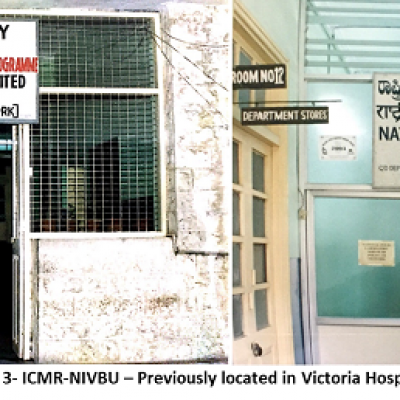
The ICMR-NIV Bangalore Unit was established in April 1970 with the primary objective of investigating and diagnosing arboviral infections. In 1975, the field station was formed by merging the Virus Research Centre Bangalore, Virus Research Centre Sagar, and the Arbovirus Laboratory at Vellore. Over the years, it has evolved into a nationally recognized centre and serves as a WHO-SEARO National Laboratory for Polio, Measles, and Rubella surveillance.
Research Activities
The Bangalore Unit undertakes surveillance, laboratory diagnosis, and research on viral diseases of national public health importance. Its findings have been published in numerous national and international scientific journals.
WHO-SEARO Surveillance Projects
National Surveillance
Laboratory Diagnosis
Mosquito Studies
VRDLN Projects
SARS-CoV-2 Projects
Significant Contributions
Scientific Staff
Technical Staff
Project Staff
Supporting Staff
Former Officers In-Charge
Infrastructure
The Bangalore Field Station is equipped with state-of-the-art laboratory infrastructure to support advanced virology research, molecular diagnostics, and surveillance of vector-borne diseases. The facility includes modern instrumentation for genomic sequencing, molecular biology, serology, and biosafety-compliant laboratory operations.
The field station is also developing advanced facilities for nanotechnology-based approaches aimed at the surveillance and control of vector-borne diseases in India.
Photo Gallery